🧠30 Pcs Human Anatomy Flash Cards – Study Guide for Medical and Nursing Staff🫁
🧠30 Pcs Human Anatomy Flash Cards – Study Guide for Medical and Nursing Staff🫁
Regular price
$24.99
Regular price
$24.99
Sale price
$49.98
Unit price
per
Couldn't load pickup availability

🧠30 Pcs Human Anatomy Flash Cards – Study Guide for Medical and Nursing Staff🫁
Regular price
$24.99
Regular price
$24.99
Sale price
$49.98
Unit price
per
A clearer view of the anatomy you’re studying 🧠
Bring key structures into focus with 30 compact cards featuring color-coded diagrams and labeled anatomical terms.

For the work between lectures, labs and shifts
Designed for medical and nursing study, this deck offers a practical visual reference for learners revisiting structures and terminology alongside their coursework.
Make room for small, focused study sessions.
Work through a diagram at your own pace
Use these four steps to give each topic a focused pass.

-
Choose your topic
Select a card that connects with your current lecture, lab or revision plan.
-
Look at the illustration
Study the shapes and color blocks before reading through the terminology.
-
Follow the labels
Trace the pointer lines to connect each anatomical term with its structure.
-
Return to tricky areas
Set aside the topics you want to revisit in your next study session.
Specific structures, clearly identified
The supplied topic examples show the range of anatomical detail in the deck.

Brain landmarks
Brain lobes and cranial landmarks are among the subjects available for review.
Respiratory anatomy
Lungs and respiratory tract topics include labeled structures such as the cricoid cartilage.
Nephron structure
The nephron is included among the deck’s focused anatomical subjects.
Adrenal gland layers
Adrenal anatomy includes specific terminology such as Zona Glomerulosa.
Three ways to work with the deck
Adapt your review to the material you’re covering.

Pair with course reading
Keep a related diagram beside your notes while working through anatomical terminology.
Review aloud
Name the structures you recognize, then check their printed labels.
Create a focused selection
Pull out the cards relevant to your current topic and revisit that smaller group.
A practical format for regular review
Four core features shape the study experience.

-
📇
30-card set
Keep multiple anatomy topics together in one portable collection.
-
🌈
Multi-color printing
Color blocks help distinguish structures within the illustrations.
-
✏
Printed anatomical labels
Review the terminology directly alongside the diagrams it describes.
-
📏
Compact card size
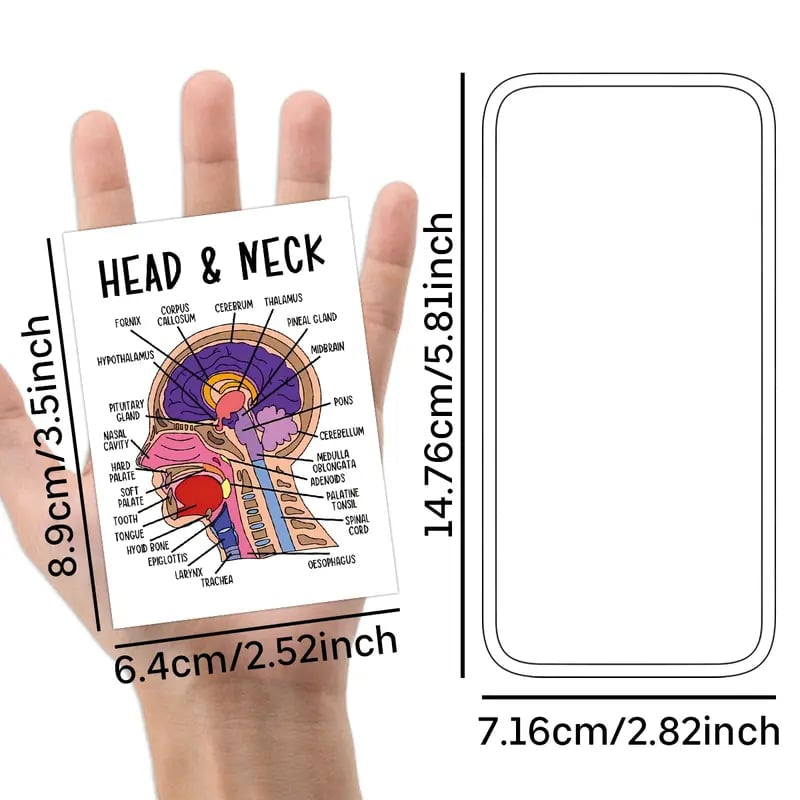
Each card measures approximately 3.5 × 2.5 inches for convenient carrying.
A little anatomy review fits here
Keep the deck handy for planned sessions and short pauses.

Between classes
Take a card from your study pouch and revisit a diagram before your next lecture.
Beside your question bank
At your desk, lay out a relevant card while reviewing questions on the same anatomical area.
For someone building their anatomy knowledge
A compact study aid can be a thoughtful addition to a learner’s routine.

A nursing graduate
Mark graduation with a practical reference for continued anatomy review.
A nurse during Nurses Week
Choose a study-focused gift for someone who enjoys revisiting anatomical knowledge.
A medical student
Give a portable visual study aid to someone working through anatomy coursework.
Consider your topics and your study habits
These two checks can help you decide how the deck fits your routine.
Check the subject fit
Compare the listed topics, including head and neck, eye, ear, tongue and thyroid, with the areas you want to review.
Check the format fit
Consider whether small, printed diagrams suit your preference for portable, hands-on study.
Useful across different review routines
The deck suits learners who want a compact visual companion to their study materials.
Medical students
Connect anatomical names with illustrations while revisiting course topics.
Nursing students
Keep labeled anatomy references nearby throughout your coursework.
Visual learners
Use diagrams and color-coded structures as reference points for terminology.
Exam review sessions
Work through selected topics as part of your broader revision plan.
Know what you’re choosing
Set size30 human anatomy flash cards.
Approximate card dimensions8.9 × 6.4 cm, or 3.5 × 2.5 inches.
MaterialPaper cardstock.
PrintingMulti-color anatomical illustrations with printed labels.
Topic examplesBrain, lungs, respiratory tract, head and neck, eye, ear, tongue, thyroid, nephron and adrenal gland.
Intended useVisual anatomy study, quick reference and repeated review.
Get familiar with the format
How many cards are included?
The set contains 30 human anatomy flash cards, each focused on a labeled anatomical topic.
Which anatomy topics are covered?
Examples include the brain, lungs, respiratory tract, head and neck, eye, ear, tongue, thyroid, nephron and adrenal gland structures.
How large is each card?
Each card measures approximately 8.9 × 6.4 cm, or 3.5 × 2.5 inches.
What are the cards made from?
They are made from paper cardstock with multi-color printing.
Can I use them for exam revision?
Yes. They are designed as a compact visual study aid for reviewing anatomy topics alongside your course materials.
How are the diagrams organized?
The cards use color-coded structures, pointer lines and anatomical labels to support topic-by-topic visual review.
Give your next study session a visual starting point
Choose a topic, follow the labels and return to the structures you want to know better. This compact 30-card deck fits naturally into a regular review routine.
Choose This Study SetPaper cardstock cards with multi-color labeled diagrams; dimensions are approximate.